
Forum
Market
- Støpetang 43 Spanish
- Rogers & Spencer
- Ekte krutthorn
- Støpeblokk 44 heelbase + crimp + hylseholder
- Nagant deler
- Flintlås pistol
- Ideal ladetang kombinert med kuletang til 38 S&W M
On this day
23 April 1716
The Second Battle of Moss was one of the few major clashes during Charles XII’s first campaign in Norway in 1716. Between 2,000 and 3,000 soldiers took part in what became a hard and bloody battle. The Norwegian capture of Moss completed the... Read more ...
The Second Battle of Moss
The Second Battle of Moss was one of the few major clashes during Charles XII’s first campaign in Norway in 1716. Between 2,000 and 3,000 soldiers took part in what became a hard and bloody battle. The Norwegian capture of Moss completed the strategy of cutting off the Swedish army of about 6,000 men in and around Christiania.
The loss of Moss forced the Swedes to withdraw from Christiania a week later.
Thirty Norwegians and one hundred Swedes were killed in the fierce fighting, and many more were wounded. Although the Swedes had mounted a strong defense against the Norwegian troops, the entire garrison was wiped out, with 100 dead and a large number taken prisoner. Forty-three officers and non-commissioned officers together with 468 privates — between 511 and 520 Swedes in total — were captured. Over the course of the two battles of Moss, the Swedes had now lost more than a thousand men, most of them prisoners.
Featured article

The flint and percussion locks are the most commonly used ignition systems used in today\'s black powder firearms. Other systems, such as matchlock, snaphaunce and wheellock are also used, but in more limited quantities. This article gives you a brief overview of the different systems.
Different Firearms Ignition Systems
Some Thoughts About Selecting Barrels
 About
About Les artikkel på norsk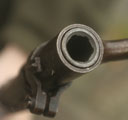
M/1867 Remington.
The relationship between rifling twist, rifling depth and calibre is important. The art of rifling barrels has been known for over 500 years, so it is not a modern invention. The rifling consists of several grooves that are cut as a spiral inside the barrel. The task of the rifling is to give the projectile a rotating spin in the air. The spin ensures better stability and increased accuracy. The rifling twist is perhaps the most important factor, but also the most overlooked regarding barrel selection.
Find out more!
You can learn more about selecting barrels for muzzle-loading and black powder cartridge guns in the brand new book From Musket to Metallic Cartridge: A Practical History of Black Powder Firearms.

Different types of rifling.
In the old days the barrels were rifled in rifling benches which was a time-consuming process (see the Longrifle Project). Today few of the mass-produced black powder weapons have cut rifling. Instead the rifling is made by a button that is pulled through the barrel. This only takes a few seconds. It is difficult to make deep button rifling and that it the reason why many cheap muzzleloading rifles have rifling that is, in my opinion, too shallow.
Glossary
Rifling twist: The rifling twist is measured in how many turns the spiral of the rifling makes in a given length. 1 in 48" means that the spiral makes one full turn in 48".
Rifling depth: The depth of the grooves. See the illustration below.
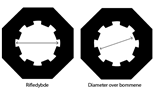
Bore diameter and
rifling diameter.
The general rule is that roundballs should have a slow twist to achieve best accuracy, while conical bullets works best with faster twists. If you use a twist that is somewhere in between you may use both roundballs and conicals. I addition, the rifling depth and number of grooves are factors that must be considered. Deep rifles work best with roundballs, while shallow rifling is best suited for conical bullets.
Some black powder rifles have fast 1:18"-1:20" twists. This applies to most Sharps and Remington rolling block replicas in .45-70 Gvt. .40 calibre rifles often have an even faster 1:16" twist. The size of the calibre influences how fast or slow the rifling should be. Small calibre weapons must have faster twist compared to large calibre weapons. An example from modern firearms: .17 Remington has 1:9" as standard while .308 Win. has 1:12".
This means that .40 and a .58 calibre rifle have different standards. Confused? See the list below for an overview.
Example: .50 calibre muzzleloading rifle
Let's use a .50 calibre muzzleloading rifle as example.
.50 calibre and patched roundballs:
As previously mentioned the grooves should be deep for best results with roundballs. The reason is that a piece of cloth is used between the ball and the barrel, and to enable the rifling to get a good grip of the patch the rifling must be deep. In a .50 calibre rifle a groove depth of .010" to .018" is suitable for roundballs.
In my opinion, the rifling twist should not be faster than 1:60". My favourite twist is the 1:72". This twist shoots well with several different cloth thicknesses and powder charges. The disadvantage, at least to some, is that you often have to use a heavy powder charge to achieve best possible accuracy. 1:66" is regarded by many as optimal.
The number of grooves is also a factor. Roundball barrels often have up to 8 grooves, while barrels intended to shoot conical bullets have fewer.
.50 calibre and conical bullet
With a conical bullet it is meant bullet types such as minié balls, maxi balls, Great Plains bullets, R.E.A.L. bullets or other long bullets. The rifling should be a bit shallower if you want to shoot conical bullets. .005" to .006" groove depth should be adequate. With such shallow rifling the grooves get a good grip of the lead and virtually screw the bullet out of the barrel. If the rifling is too deep the powder gases may blow by the bullet and ruin the accuracy.
1:24" to 1:28" twists should be optimal in a .50 calibre muzzleloading rifle and conical ball. If you use roundballs in such a slow twist you may experience serious accuracy problems, but you may want to try lower charges. These twist were actually quite common in large bore European Jaeger rifles in the 1700s, but the accuracy would probably have been better with slower twists.
.50 calibre and both roundball and conicals
Actually, most replica muzzleloading rifles being made today are made to shoot both roundballs and conical bullets. These rifles have what I call a compromise twist. Every compromise involves some give and take, and often the result is just halfway satisfying. This is my experience with compromise twists.
1:48" is a compromise which allows the shooter to use both roundball and conical bullets. If you want to shoot roundballs with a 1:48" twist you should try low charges, while conical bullets often require heavy loads. The Hawken brothers in St. Louis used the 1:48" twist in their rifles, so the twist is actually historically correct.
Recommended twists in a give calibre
|
Calibre |
Roundball twist |
Conical twist |
Compromise |
| .36 | 1:48 | 1:16 | |
| .40 | 1:48 | 1:16, 1:18 | |
| .45 | 1:60, 1:66 | 1:18, 1:20 | 1:48 |
| .50 | 1:66, 1:70, 1:72 | 1:24, 1:28 | 1:48 |
| .54 | 1:70, 1:77 | 1:28, 1:32, 1:38 | 1:56 |
| .58 | 1:70, 1:72, 1:83 | 1:32, 1:38, 1:48 * | 1:60 |
| .60 |
* = .58 calibre rifle muskets which were made to shoot minié balls often had 1:66", 1:72" or 1:78" twists. The reason is that the slow twist should reduce the horizontal drift on long ranges. Still, they are accurate with minié balls, but that they may be picky about powder charge. See the article about Rifle muskets and minié balls.