Forum
Market
- Mauser 1871/84 utdrager
- Ekte krutthorn
- Støpeblokk 44 heelbase + crimp + hylseholder
- Nagant deler
- Flintlås pistol
- Colt M1851 Navy conversion 38rf
- Diesett
On this day
16 April 1746
The Battle of Culloden was the final confrontation of the Jacobite rising that had begun in 1745. On this day in 1746, the Jacobite forces of Charles Edward Stuart fought the loyalist troops under William Augustus, Duke of Cumberland, near Inverness... Read more ...
Battle of Culloden
The Battle of Culloden was the final confrontation of the Jacobite rising that had begun in 1745. On this day in 1746, the Jacobite forces of Charles Edward Stuart fought the loyalist troops under William Augustus, Duke of Cumberland, near Inverness in the Scottish Highlands.
The Hanoverian victory at Culloden ended the Jacobite attempt to overthrow the House of Hanover and restore the House of Stuart to the British throne. Charles Stuart never made another attempt to challenge Hanoverian control over the Kingdom of Great Britain. The conflict was the last pitched battle fought on British soil.
![]()
Featured article

During the heyday of the percussion revolver soldiers almost exclusively loaded their revolvers with paper cartridges. This article gives you a short historical background of the use of paper cartridges, shows you how to make your own and finally how to shoot them.
Making paper cartridges
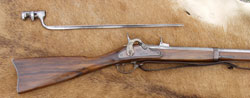
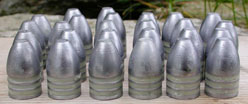
Rifle musket and Minié Ball
AboutPublished: 24 November 2007 by Øyvind Flatnes.
Edited: 24 November 2007.
Views: 69061
Les artikkel på norskFind out more!
You can learn more about the history and use of the rifle musket and Minié ball in the brand new book From Musket to Metallic Cartridge: A Practical History of Black Powder Firearms.
Most original muskets have a special progressive depth rifling. The grooves were deeper at the breech area and became shallower towards the muzzle. Usually .015" deep in the breech and .005" towards the muzzle. Unfortunately, very few replica musket manufacturers rifle their musket barrels this way today. Parker Hale in Birmingham, England made Enfield replicas with progressive depth rifling, but the machinery is now sold to Italy. I don't know if the quality of the Italian replicas are as good as the Birmingham Parker Hales.
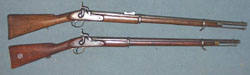
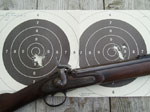
If you have a "normal" replica rifle musket you should be able to put 5 shots in a 1,5" group at 100 yards. You should then pick a bullet that is about .002-.001" under the land diameter of the barrel. I'll use my Armi Sport .58 calibre 1861 Springfield musket as an example: It measured .581" across the lands. Then I had to have a minié bullet that had a .580" diameter. You'll notice that most of the moulds available has a diameter that ranges from .575" to .578". If you need a larger diameter you'll have to special order a largerr one or somehow enlarge the cavity.Finding the Right Powder Charge
If you have a minié ball of the right diameter you're on your way to get some acceptable accuracy. Warning: the work of finding the best charge could take ages! A charge of 55 grains can shoot great while a 56 or 54 grains charge can open the group considerably. I use to start with a low charge and build my way up with a .5 grain increasement. 2F or 3F? Well, it all depends on what your musket likes. The original US charge was about 60 grains black powder and the UK Enfield charge was 70 grains. I have never experienced that a musket has performed well with at normal minié bullet with charges over 80 grains. The reason for this is that the skirts get blown which affects accuracy. Start some place in the 35 grains range with 3F and 40 grains for 2F. It could take some time before you get the 1,5" group at 100 yards, but at he end it's worth it. Shoot from a bench rest and remember that it doesn't matter where on the paper the bullets hit as long as they are grouped. Sights can be adjusted later. I prefer to start the shooting at 100 yards because some loads will shot great at 50 yards but lousy at 100. Never a problem the opposite way though. Another important factor to consider is the bullet lube. It's purpose is to keep the fouling soft and lubricate the bore. Tallow and bees wax was the original lube, and that also works ok today. My Springfield shoots best with T/C Bore Butter. It is kind of sticky and slick, but I have not found anything that works better. If the fouling gets hard it is about time to consider a new lube. I use to feel with a finger in the bore after each shot, and then the fouling should be soft. On hot, dry days har fouling could be a problem, but if you wait a little longer between each shot it should work itself out. Some like to put grease in the base of the bullet, some do not like it. I prefer lube in the base, but not a single gun likes the same thing it seems. Here are 5 points that you should follow to get the best accuracy with a minié ball:- Weigh your bullets to +/- one half grain.
- Weigh your powder to +/- .1 grain.
- Be consistent in what you're doing. Do everything exactly the same.
- Use powder and caps from the same lot.
- Cast your bullets from pure lead.