
Forum
Market
- Winchester 1886 45-90
- Parker Hale Volenteer 451 3 bånd
- Våpenskap for lange våpen
- Svartkrutt
- Tomhylser Spencer 52-50
- colt 1873 tønne cal 45 longcolt
- Winchester 1887 Deler å hylser i kaliber 10
On this day
5 October 1877
Nez Perce chief Joseph surrendered himself and his people to General Nelson A. Miles. They had fled more than 1,880 kilometers through Idaho, Yellowstone and Montana with the U.S. Army on their heels. After being turned away by the Crow, they tried... Read more ...
Chief Joseph surrendered to General Miles
Nez Perce chief Joseph surrendered himself and his people to General Nelson A. Miles. They had fled more than 1,880 kilometers through Idaho, Yellowstone and Montana with the U.S. Army on their heels. After being turned away by the Crow, they tried to reach Canada and the protection of Sitting Bull. They fought 18 skirmishes during the retreat but were finally defeated at Bear Paw, only a few miles from the Canadian border.
Featured article
Most old military longarms had sling swivels, but their original leather slings are usually long gone. Replica firearms are rarely sold with slings, but making a sling that fits you and your musket or rifle is pretty simple. This article shows you how to do it.
Making a Target or Carrying Sling
Home-Made Hammer Swaged Bullets
 About
AboutPublished: 19 September 2008 by Øyvind Flatnes.
Edited: 19 September 2008.
Views: 41784
 Les artikkel på norsk
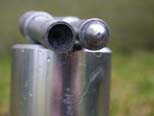
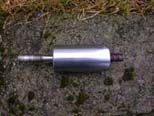
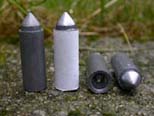
Hammer swage and bullets.
During the latter part of the 1800s many competitive muzzleloading shooters used so called 'hammer swages' which was a die where the bullets were swaged by the force of a hammer. The muzzleloading schuetzen rifles that used such bullets often had a false muzzle to facilitate the loading of the heavy paper patched slugs. A hammer swage is not difficult to make if you have access to a lathe. Swaged bullets normally don't have grease grooves and are best suited for paper patching.
My attempt to make a prototype of a hammer swage was actually quite successful. The swage is made up from three parts: a steel cylinder which is bored exactly to the diameter of the finished bullet, a bolt that forms the bullet base and a bolt that forms the bullet nose. The tool is simple to use. A lead slug with a light coating of RCBS case lube is inserted into the cylinder. The nose forming bolt is inserted in one end of the cylinder and the base forming bolt into the other. The bullet is formed with a couple of hard blows from a hammer against the base forming bolt. That's it, and the finished bullet can be removed from the cylinder.
Find out more!
You can learn more casting and swaging bullets for black powder guns in the brand new book From Musket to Metallic Cartridge: A Practical History of Black Powder Firearms.
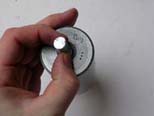
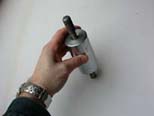
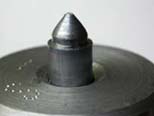
Hammer swaging process.
The nose of my prototype bullet looks ridiculous, but it only meant as a just a test. To say the least, it is not very aerodynamic! I have now modified the nose so that it looks a bit better, and it actually shoots ok in the Martini-Henry. The advantage of a hammer swage like this is the opportunity to make a number of different nose and base forming bolts. The length can also be varied until you have a bullet that is optimal for your rifle. To change the diameter of the bullet you need to make a new cylinder.
The disadvantage of swaged bullets is the production time. First you must make the lead slug from which the bullet is swaged. If you have access to lead wire you will save some time, but at least here in Norway, lead wire is not readily available. On the other hand it is simple to cast a couple of hundred slugs that can be used to swage bullets in a number of different calibres. If you simply want to experiment with a few bullets it takes less time to swage them compared to start melting lead, wait for it to heat, heat the moulds and cast a couple of bullets. I have tested the bullets briefly, and you can see the results in the article about the .577/.450 Martini.Henry rifles.


From left to right: A basis bullet, a finished bullet from the hammer swage and a paper patched bullet from the hammer swage. Picture 2: Bullet nose and cup base. Picture 3: Two swaged lead bullets. Finally, a cut away drawing of hammer swage.