
Forum
Market
- Våpenskap for lange våpen
- Svartkrutt
- Wano svartkrutt
- Tomhylser Spencer 52-50
- Jemttang 15,5mm søkes
- colt 1873 tønne cal 45 longcolt
- Winchester 1887 Deler å hylser i kaliber 10
On this day
28 September 1874
The Battle of Palo Duro Canyon between the U.S. Army and an alliance of Kwahadi Comanche, Kiowa, Cheyenne and Arapaho helped bring the Red River War to an end. Ranald S. Mackenzie's troops launched a surprise attack in the Texas Panhandle.... Read more ...
The Battle of Palo Duro Canyon
The Battle of Palo Duro Canyon between the U.S. Army and an alliance of Kwahadi Comanche, Kiowa, Cheyenne and Arapaho helped bring the Red River War to an end. Ranald S. Mackenzie's troops launched a surprise attack in the Texas Panhandle. Relatively few Native people were killed, but Mackenzie captured or destroyed their winter supplies and 1,500 to 2,000 ponies, and all the tipis were burned. Without ponies and provisions many were forced back to the reservation at Fort Sill.
Featured article

Loading a kammerlader with paper cartridge
Loading a kammerlader with paper cartridge
Muzzleloader and Patched Roundball
 About
AboutPublished: 24 November 2007 by Øyvind Flatnes.
Edited: 24 November 2007.
Views: 29938
 Les artikkel på norsk
The patched roundball is said to be an early American invention, if it's right I don't know. It was used in the American woods from around 1740, probably a little earlier. The principle behind the patched roundball is simple: By wrapping the undersized roundball in a piece of greased cloth and then forcing it down the barrel the problem of loading a rifle without hammering the bullet down the bore was solved. The patch was as mentioned greased, often with bear fat. The fat helped keeping the fouling soft, which also made the loading easier. The most common patching material was linen or cotton which had to be tightly woven to survive the travel up and down the bore. Some will claim that leather (buckskin) was used as patching, but I doubt that was very common. Leather was too costly for a hunter or farmer to be shot out of a rifle.
Find out more!
You can learn more about the history and practical use of muzzle-loading rifles and patched roundballs in the brand new book From Musket to Metallic Cartridge: A Practical History of Black Powder Firearms.
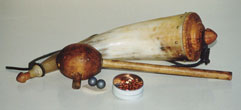
Loading equipment.
Loading a Rifled Muzzleloader with Roundball
The things you need are:
- A muzzleloading rifle with flint or percussion ignition.
- Black powder and caps (or flints if it's a flintlock.)
- Some roundballs.
- Linen or cotton patches. Denim is good too.
- Bullet lube. Some people use saliva.
- A bullet starter.
The Patch
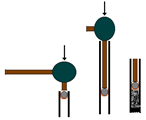
Bullet starter.
The thickness of the patch is determined by the relationship between the groove diameter of the rifle and the roundball you are using. Let's say you are using a .50 cal. rifle who's groove diameter is .509". The bullet you are using has a diameter of .495". By calculating it as follows you can get an idea of how thick the patching should be: Groove diameter: .531" minus ball diameter : .495" = .036" i difference. Now we can divide .036" in two and minimum thickness will be .018". (There will be cloth on both sides of the bullet, that's why we divide it by two). The thickness of the patches and the bullet diameter can be measured with a micrometer.
The process of loading
1. Make sure that the barrel is dry, run a few dry patches up and down the bore. (Never run a dry patch down a bore with fouling in it or it will get badly stuck down there.) Snap off a few caps if it is a percussion gun. This dries/burns up any remaining oil in the nipple.
2. Measure or weigh up a suitable charge and pour it down the barrel. A rule of thumb is 50 grains for .50 cal. rifle, 45 grains for a .45 cal. and so on. Keep your face away from the muzzle in case the charge ignites.
3. Place a greased patch over the muzzle.
4. Place a roundball on the patch and center it. Push it down with the thumb until it is flush with the muzzle, or as far as you get it. Tight fitting combinations can be hard to push with the thumb.
5. Take your starter and place it on the ball as shown below. Give it a quick thump.
6. Do the same thing with the long rod on the starter. See illustration below.
7. Take your ramrod and gently push the ball down the bore until it is seated against the powder. There should be no air gap between the ball and powder. That could make the barrel blow up. See below. Again, remember to keep your face away from the muzzle, the gun is now loaded. Also remember to keep the muzzle in a safe direction at all times!
8. Remove the ramrod from the barrel.
9. Cap the rifle if it is a percussion or prime it with priming powder if it is a flintlock.
10. Cock the hammer and fire!