
Forum
Market
- Løpsemne cal 50
- Kuletang 45lC
- 8mm Kongsberg Rolling Block
- Hylser til 12,17x44r
- Winchester 1886
- Ruger Old Army kal.45
- Parker Hale Enfield
On this day
19 October 1813
The Battle of Leipzig, or Battle of the Nations, was fought at Leipzig, Saxony. The coalition armies of Russia, Prussia, Austria, and Sweden, led by Tsar Alexander I of Russia and Karl Philipp, Prince of Schwarzenberg, decisively defeated the French... Read more ...
The Battle of Leipzig
The Battle of Leipzig, or Battle of the Nations, was fought at Leipzig, Saxony. The coalition armies of Russia, Prussia, Austria, and Sweden, led by Tsar Alexander I of Russia and Karl Philipp, Prince of Schwarzenberg, decisively defeated the French army of Napoleon I, Emperor of the French. Napoleon's army also contained Polish and Italian troops, as well as Germans from the Confederation of the Rhine. The battle was the culmination of the 1813 German campaign and involved nearly 600,000 soldiers, making it the largest battle in Europe prior to World War I.
Being decisively defeated for the first time in battle, Napoleon was compelled to return to France while the Coalition hurried to keep their momentum, invading France early the next year. Napoleon was forced to abdicate and was exiled to Elba in May 1814.

Featured article
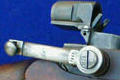
Picture series that show a 18 bore naval kammerlader converted according to Landmark's system. If you want to know more about kammerladers, you can read the articles in the "Kammerlader" category. You find the categories in the top menu.
Landmark kammerlader conversion
Smoothbore Musket and Paper Cartridge
 About
AboutPublished: 24 November 2007 by Øyvind Flatnes.
Edited: 24 November 2007.
Views: 59767
 Les artikkel på norsk
A picture of a target which I shot from the standing position with my Pedersoli .75 cal. Brown Bess carbine loaded with paper cartridges from a distance of 35 yds. The cartridge consisted of a .735" ball dipped in a mixture of deer tallow and bees wax and 90 grs. of 1F powder. You would probably get better results with a patched roundball, but what the heck, I'm satisfied anyway!
Sometime during the 17th century the armies of the time began to use the paper cartridge for their muskets. Before, the musketeers had used a bandoleer with the desired amount of gunpowder measured beforehand which was kept in a tubular wooden container. This was an inconvenient way to carry the ammunition because the ball had to be kept in a pouch separately from the powder. Loading a musket was by then a time consuming process.
Find out more!
You can learn more about the history and use smooth-bore muskets and paper cartridges in the brand new book From Musket to Metallic Cartridge: A Practical History of Black Powder Firearms.
Loading a Musket with Paper Cartridge

.75 cal. musket cartridge.


The greased paper around the ball will work as some sort of crude patching. I have experienced that if the excess paper is torn away (all the paper that isn't greased) accuracy will be best.


Now we can prime our musket. I normally use 4F for this, but I have also tried 3F, 2F and even 1F powder. The musket will ignite with all of them, but the coarser the priming powder is, the slower the ignition time will be.

BANG!