
Forum
Market
- Rullekrymper til hagle kal 12
- Løpsemne cal 50
- Kuletang 45lC
- 8mm Kongsberg Rolling Block
- Hylser til 12,17x44r
- Winchester 1886
- Ruger Old Army kal.45
On this day
19 October 1813
The Battle of Leipzig, or Battle of the Nations, was fought at Leipzig, Saxony. The coalition armies of Russia, Prussia, Austria, and Sweden, led by Tsar Alexander I of Russia and Karl Philipp, Prince of Schwarzenberg, decisively defeated the French... Read more ...
The Battle of Leipzig
The Battle of Leipzig, or Battle of the Nations, was fought at Leipzig, Saxony. The coalition armies of Russia, Prussia, Austria, and Sweden, led by Tsar Alexander I of Russia and Karl Philipp, Prince of Schwarzenberg, decisively defeated the French army of Napoleon I, Emperor of the French. Napoleon's army also contained Polish and Italian troops, as well as Germans from the Confederation of the Rhine. The battle was the culmination of the 1813 German campaign and involved nearly 600,000 soldiers, making it the largest battle in Europe prior to World War I.
Being decisively defeated for the first time in battle, Napoleon was compelled to return to France while the Coalition hurried to keep their momentum, invading France early the next year. Napoleon was forced to abdicate and was exiled to Elba in May 1814.

Featured article

It may be discussed whether cast or swaged bullets are best. Of course, both have its advantages, but the disadvantage with swaged bullets is that they are harder to make for the average shooter. However, it is not impossible. This article shows you the simple way to swage bullets using a homemade hammer swage.
Home-Made Hammer Swaged Bullets
18 Bore Kammerlader Bullets
 About
AboutPublished: 15 October 2008 by Øyvind Flatnes.
Edited: 15 November 2008.
Views: 32713
 Les artikkel på norsk
Many Norwegian black powder shooters have an old kammerlader lying around. If it is in good condition you can shoot it, but it may prove difficult to obtain proper bullets.
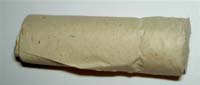
Original paper cartridge Model 1861.
Find out more!
You can learn more about the Norwegian kammerlader rifles and their ammunition in the brand new book From Musket to Metallic Cartridge: A Practical History of Black Powder Firearms.
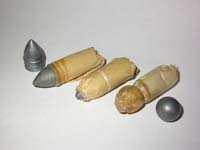
Replica paper cartridges and bullets.
The original conical bullets

Conical bullet and cartridge used
by sharpshooters from 1849-1855.
You can ask yourself why a bullet that was supposed to be paper patched had grooves, unlike, for example, the smooth sided British paper patched Pritchett bullet that was used in the .577 Enfield muskets. The idea behind the grooves was not that they should be used as lubrication grooves, or grooves for scraping out powder fouling. A woollen thread was used to secure the patching paper to the bullet, but the thread was not tied in the grooves. Instead the thread was tied once in front of the nose and then behind the bullet. A lubricated thread in the grooves would probably have provided better lubrication than just the lubricated paper, but that's easy for us to say that can lean on 150 years of experience with the kammerlader. The explanation is probably that the grooves, or 'air grooves' as they were called, were supposed to move the weight of the bullet forward. By removing a lead by making the grooves it was tried to stabilise the bullet more in addition to the rotation stabilisation.


To the left: Copy of the sharpshooter bullet from 1849, and to the right
an original bullet of the type that was used from 1855.
The kammerlader bullets today
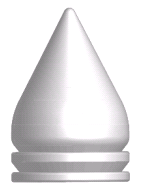
Drawing of the
Model 1855 bullet.
I copied an original Model 1855 bullet and sent drawings to both Lee Presicion and NEI Handtools which both made moulds for me. The Lee moulds are of course made of aluminum, while the NEI moulds are manufactured in meehanite, which NEI describe as 'a very dense, free machining cast iron alloy'. I have had good results with these bullets, and there are about 50 of these moulds in circulation among Norwegian, Swedish, Dutch and American kammerlader shooters.