
Forum
Market
- Låser til hanehagler
- Kongsberg Sabelbajonett M/1851 nr. 650
- 12,17X44 omformingsverktøy fra 348
- Snidler Endfield
- Avtrekksmekanismer
- Avtrekker bøyle
- Diesett
On this day
9 June 1815
The Congress of Vienna, which took place in Vienna, Austria from October 1814 to June 1815 to regulate and restore Europe's political conditions after the Napoleonic Wars, was concluded. During the congress, it was decided that Norway should be... Read more ...
The Congress of Vienna was concluded
The Congress of Vienna, which took place in Vienna, Austria from October 1814 to June 1815 to regulate and restore Europe's political conditions after the Napoleonic Wars, was concluded. During the congress, it was decided that Norway should be transferred from Denmark to the Swedish king.
The Congress of Vienna was the third large peace congress in modern times, and almost all of Europe's states and princely houses took part. The five major powers' delegation leaders were Metternich for Austria, Castlereagh for Great Britain, Tsar Alexander I and Nesselrode for Russia, Hardenberg and Humboldt for Prussia, and Talleyrand for France.
Representing Sweden was Count Carl Axel Löwenhielm, and representing Denmark was Foreign Minister Count Niels Rosenkrantz. King Frederick VI was also present.
The congress came about as the work of the Austrian Foreign Minister Prince Metternich, and his rejection of the liberal and national ideas of the time left its mark on it.
Featured article
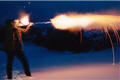
What is black powder shooting? What is black powder used for? Is it something for me? This article is meant as an introduction to the sport of black powder shooting, and it is also recommended as an introductory text to the svartkrutt.net web site. \"Svartkrutt\" means “black powder” in Norwegian.
What is Black Powder Shooting?
Rifle musket and Minié Ball
 About
AboutPublished: 24 November 2007 by Øyvind Flatnes.
Edited: 24 November 2007.
Views: 69538
 Les artikkel på norsk
.58 calibre Springfield rifle musket.
Find out more!
You can learn more about the history and use of the rifle musket and Minié ball in the brand new book From Musket to Metallic Cartridge: A Practical History of Black Powder Firearms.

Expanding bullets.
Most original muskets have a special progressive depth rifling. The grooves were deeper at the breech area and became shallower towards the muzzle. Usually .015" deep in the breech and .005" towards the muzzle. Unfortunately, very few replica musket manufacturers rifle their musket barrels this way today. Parker Hale in Birmingham, England made Enfield replicas with progressive depth rifling, but the machinery is now sold to Italy. I don't know if the quality of the Italian replicas are as good as the Birmingham Parker Hales.

Two Enfield muskets
Finding the Right Powder Charge

Lubricated minié balls.

Accuracy.

Replacement sight.
- Weigh your bullets to +/- one half grain.
- Weigh your powder to +/- .1 grain.
- Be consistent in what you're doing. Do everything exactly the same.
- Use powder and caps from the same lot.
- Cast your bullets from pure lead.